Tuesday, October 31, 2006

More on Rowing Well For Boat Speed

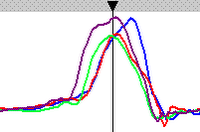
I came across a blog entry on Coach Thrasher that led me to a short analysis that provides some underpinning for the technique vs. erg discussion that the Pitt four's HOCR performance engendered. Of course, there are many factors that go into technique and no single factor is totally predictive, but this timing analysis provides one piece of the technique puzzle.

The charts relate to the oar pressure of rowers in a four. In "Coach Thrasher's" words, the underlying idea is that

"the force applied to the boat is the SUM of everyone rowing. If we can sum the peak-power for each rower at the same point in time, we'll get the MAXIMUM force applied to the water to move the boat forward the fastest. The higher this maximum force, the faster the boat will go, but the maximum force is the sum of everyone's efforts, so it's important to time it well. (Obviously there are many factors that contribute to boat speed as well, but this force-timing is really important in small boats.)"

"Note an important aspect of this: the boat will go faster by having the best timing, not by hammering the oar through the water! So a weaker crew with better timing will go faster than a stronger yet sloppy crew."

Now, take a look at the graphs. The difference is obvious, but at first may not seem terribly huge. We're told, however, that the better crew is going about 0.3 m/s faster, which works out to about 30 seconds over a 2000m course. Next, think about all the lightweight fours rowing over nearly 5000 meters at the HOCR. If Pitt's power application curve looked like that of the best crew in this analysis, and everyone else looked like the worst (not impossible), it would take a mighty strong crew to hammer the oar through the water hard enough to beat them.

This sort of thing can be difficult to see by the untrained observer, but that is why we have coaches and not personal trainers. As the Peach web site says, "A coach can identify these differences in terms of body movement, posture, sequencing of legs, trunk and arms during the drive etc."

There are a zillion other factors at play here, of course, and I have no idea if Pitt's advantage was power application timing. It may have been something else. For example, even within power application, the moment of maximum application is important too. The point is that seemingly small differences in technique and timing can make large differences in boat speed.


Monday, October 30, 2006

Head of the Iowa and More

I was a bit slow on more results and a reader beat me to the Head of the Iowa:

Wisco lights won Gold medals in the Open Women's Pair and Light Four at the head of the Iowa. They finished 8th in the Open women's eight race. The Badgers actually had the 2nd and 3rd fastest times of the day in the pair, but penalties moved the 3rd fastest pair on the water into gold medal position. Badgers finished 1st, 2nd and 4th in the LW4+, but 2nd place crew was penalized and moved into third.
These sound like pretty good results to me. In the eight Wisconsin beat 22 heavyweight boats, including the top boats from Grand Valley, Kansas State, Drake, Marquette, and Creighton.

At the Head of the Tennessee, Dayton beat Virginia Tech by 13 seconds in the light eight (Atlanta scratched) and Georgia State handily beat Auburn, Virginia Tech, and UTC in the light four. Georgia State was 1:38 ahead of second place Auburn. Both Dayton and Georgia State were favored (by FITD anyway) in these races.

At the Head of the Fish Buffalo was just over a second faster than Fairfield in the light four. Fairfield was followed by UMass, Brandeis University, University of Vermont, and Buffalo B. It looks like a light eight race was scheduled but no times are given.

At the Speakmon Memorial Regatta Ohio State took the light four race easily (43 seconds) over a second place high school crew. Miami University and Wittenberg University were fourth and fifth.


Sunday, October 29, 2006

Head of the American Results

Cal and Stanford raced in the Collegiate Eight event at the Head of the American today. Both boats finished in the second half of the pack of heavyweight boats, with Stanford finishing about a minute ahead of California. Stanford also raced a light four in an all heavyweight race, finishing 13th out of 17.

Princeton Chase Results

Reports from the Princeton Chase today described an extremely windy course with a dominant headwind for the last third that caused steering problems and collisions throughout the day. The fours were canceled along with the small boats.

It was a big day for Princeton as the Tigers finished 1 - 2 in the lightweight competition. The first Princeton boat finished over a minute ahead of third place Radcliffe while the second Princeton boat was 25 seconds ahead. Radcliffe, in turn, was 4 seconds ahead of Georgetown which was 23 seconds ahead of MIT. A third Princeton boat rounded out the lightweight field. Princeton must have some talent this year as it appears that the only boat capable of gaining on Princeton is, well, Princeton. The Princeton B boat was 49 seconds back from the A boat at the Head of the Potomac and has now moved to within 37 seconds. When these two crews mix and match in the spring the result has the potential to be extremely fast. To add a little more perspective, the Tiger A boat beat the Cornell, GW, BC, and Rutgers A heavyweights, while the Princeton B boat beat the Trinity, Villanova, and MIT A heavyweight boats. The top lightweight boat was a bit further back in the field this year than last, but given the wind we would expect that.

Another winner appears to be Georgetown. They closed the gap substantially on Radcliffe since Boston while moving ahead of MIT.

Although there is some racing left, the Chase closes the door on the fall races with the potential to tell us anything about the relative speed of lightweight crews. At this point we should look back at last year's Chase, keeping in mind the final spring results. Princeton also won last year (Wisconsin did not compete in either 2005 or 2006) and also beat Radcliffe by about a minute (52 seconds). Georgetown was second last year, 9 seconds ahead of Radcliffe. (Recently, Radcliffe seems to have had some problems with this race.) Princeton beat quite a few heavyweight A boats last year as well (although this year there was a lightweight killer wind).

So what does all of this tell us? I think it mostly tells us who to measure spring progress against. This spring that initial measuring stick will pretty clearly be Princeton. On the other hand, last spring the measuring stick was Wisconsin, yet we know that Wisconsin typically starts slow and they stayed true to form as Radcliffe and Princeton beat the Badgers at Knecht. Mostly what it tells us is that the fall and spring seasons are very different. Crews that excel rowing 5000 meters at a controlled 30 spm, can turn into screaming banshees, unable to control slides or match catches, in the heat of a sprint race while rowing a 36 or 38. Head races are rowed at that Goldilocks pace in which the boat is going fast enough to set it and keep the oars off the water, but not so high and hard that you think you can't go on after the first 30 strokes. Nonetheless, before you can row well high and hard, you have to row Goldilocks well.

Friday, October 27, 2006

Lightweights Fight Global Warming!

Always on the leading edge of cool, lightweight rowers were recognized on Wednesday for their contributions to the fight against global warming. A recently published study adds weight to lightweight claims that heavyweights should be taxed, with the proceeds used for anti-warming and anti-obesity programs. Certain members of the rowing community have long speculated that Title IX heavyweights were behind the US government's rejection of the Kyoto Protocol. With the release of this study, however, anonymous sources have begun to speculate about the existence of a surreptitious Axis of Warming comprised of the CRCA, the NCAA, and the US government who may have joined forces to engineer the rejection of Kyoto.

MIT Gets Some Recognition

The Tech at MIT published a nice story about the lightweights' results at the Head of the Charles. Erqi Liu echos my own sentiments when she says,

Beating Georgetown, and being so close to Radcliffe, proves that MIT crews can be competitive in the toughest league in the country. After this, and IRAs, people are taking MIT lightweights more seriously.
Much as UCF was last year, MIT may be the breakout crew of the 2007 spring season.


Head of the Schuylkill Cancelled

That stinks! A lot of teams already made the trip. Given the weather forecast, though, there didn't seem to be much of a choice.

Thursday, October 26, 2006

Racing This Weekend

The best week of the fall season continues this weekend as many crews are in action around the country.

We'll start in Philadelphia where despite a brief scare earlier today, the Head of the Schuylkill will go on as scheduled (although expect the weather to play havoc with the racing). There is a six boat light eight event as Marist, Philadelphia University (I think this may be their first year competing in crew), Holy Cross, Penn State, Pittsburgh, and Duquesne head into battle. I wonder if Pittsburgh was able to clone that light four? Marist and Holy Cross both competed in Boston but, given their four's result, I'm going to look to Pitt as the favorite in this race. There is no light four event at HOSR so that may explain why Penn State and Pittsburgh are both entering eights. There is, however, a light single event and Bucknell has three women entered.

Next we head to the Head of the Tennessee lightweight eight event. Dayton and Virginia Tech are entered, along with the Atlanta Rowing Club. My guess is that Dayton beats Virginia Tech, but Atlanta takes the race. The light four event has Auburn, Augusta Juniors (don't tell the NCAA), Berry College, Georgia State, UTC, and Virginia Tech. Coming back from Boston, Georgia State may be able to pull off a good result here.

The Speakmon Memorial Regatta has a light four event with entries from Miami University, Ohio State, and Wittenburg University, along with some other club and juniors (don't tell) crews. This should be a good race for Ohio State to blow out the carbon.

Wisconsin will make its pilgrimage to the Head of the Iowa. The Badgers will race a novice light eight against Northwestern and Grand Valley while the varsity will race light fours (3 boats) against Creighton, Grand Valley, Marquette, Northern Michigan, Northwestern, and Kansas. Kansas is an interesting boat to see here - I wonder if that is the varsity program racing lightweights or a club program. Racing in fours, it looks like Wisconsin is heading into the part of their season where they worry about rowing well a bit more than hammering the water from an eight. Watch what the good programs do and you'll begin to understand how they can row with power and technique.

Last, but certainly not least, is the Princeton Chase. I believe this race is one of the finest head races around. Only colleges race and its unique combination of the casual with the intense almost makes one think it should be called the Princeton Dialectic rather than the Chase. It has the atmosphere of a pick-up game against your biggest rivals. I'm not exactly sure who will be there, but I expect we'll see Georgetown and Radcliffe as well as Princeton. [Update: MIT will be competing as well.] The crews will also race small boats, everything from fours to pairs to doubles and even singles. If the weather is good, nothing beats this regatta.


Wednesday, October 25, 2006

Big Ergs = Fast Boats?

Unless a rower has a big erg score, that number is often a closely guarded secret (at least to the outside world). In Pitt's case, however, a reader posted the lightweight four's erg scores and they are what most observers would call modest. Only one rower is below 8 minutes for a 2k (she's at 7:52). Do you know why they don't mind letting the secret out? Because this fall, it no longer matters. What matters is on the water boat speed and that secret is already out.

Long time readers of FITD know that I consider the erg to be the best thing and the worst thing to happen to rowing in the past 30 years or so. Despite the fact that the NCAA doesn't believe the device is rowing specific, the erg's domination of rowing is complete. If you want to inspire awe, you don't talk about a boat's victories, you talk about it's crew's erg scores. Believe it or not, rowing existed Before Ergs. Back in those dark ages winter workouts consisted of lifting lots of weights and running many miles. No doubt there were coaches calculating indices from leg presses and 2 mile run times, but setting a boat was much more of an art. Now, setting a boat seems simple - line up your rowers' erg scores and cut off the list at the top four starboards and the top four ports. As they used to say about computers, no one ever got criticized for buying IBM. Well, no one ever got criticized for racing an erg boat. It's the safe thing to do, but it usually keeps you from breaking out.

What if baseball managers set their rotations by ranking pitchers by the speed of their fastball and taking the top five? Would that work? For sure you'd get a Randy Johnson out of that methodology, but you'd also get a Steve Dalkowski (left). You would not get a Greg Maddux. The truth is that an erg score, like a fastball's speed, garners lots of attention, but it only gives you a partial picture of an athlete. As the saying goes, ergs don't lie, but they don't float either. They are a very useful tool, but that's all they are.

Ergs hurt the sport of rowing when coaches allow the machine to do the coach's job. I think this happens much more in heavyweight rowing than in lightweight rowing, where some coaches aren't rowing coaches, they are personal trainers. They train their rowers on the erg in winter and then set their boats for good the first day on the water. Sure, they do the occasional pause drill, but their work is done in February. If erg scores are truly the way to set the boat, let me tell you how to train in the spring. For your spring training trip, only take your top 8 ergers (the 1V) and keep the rest at home. The way for the others to make the boat is with a better erg score, so don't waste their time on the water, keep them on the erg. During the spring season, put your 1V on the water every day, keep the rest on the erg, and test weekly. What's the point of putting a 2V on the water when the selection criteria is the erg? If they test into the boat, they'll pick up that technique thing.

If there are times to race erg boats the fall is probably one of them. If a coach can get her hammers to actually row well in the fall, she'll have the best of both worlds in the spring. Although you may be surprised to find that a boat of modest erg scores could do so well at HOCR, perhaps the more surprising notion is the idea that a boat pulled together a week or two before the race (as some of Pitt's competitors no doubt were) could beat a long-term crew. If boat speed = erg score (power and fitness) + technique (skill and chemistry) + heart, we know how Pittsburgh made up water on its rivals.

Look, all things equal, a bigger erg does equal a faster boat, but all things are never equal. A coach's job is to discover which things aren't equal and when a deficiency in one part of the equation is overcome by superiority in another. That's what a coach does, not a personal trainer.

One last thing - wouldn't it have been fun to see a Pitt eight, cloned from the Pitt four, race in the light eight event? Who do you think would've won that contest?

HOCR Pictures

HOCR pictures are now posted to the FITD Flickr account. I have HOCR 2006 Lightweights
light eight and
HOCR 2006 Lightweights
light four pictures, although I wasn't able to get everyone (sorry).
PICT0004
Like everyone else, I also have some Beijing U. sinking pictures. Unfortunately I uploaded them last so now they show up first in the group.

[Update: At the request of readers, the pictures have been removed. Also at the request of readers, FITD will not show pictures of any crews mentioned.]

Tuesday, October 24, 2006

Sportsmanship Lives

In an age when every athletic contest seems to be an opportunity to find new ways to mock one's opponent and aggrandize oneself, we were offered a lesson in sportsmanship by the Undine, Penn State, and U Vic light four crews and coaches on Sunday.

Those of you who checked the light four results shortly after they were posted on Sunday saw U Vic in first by virtue of a buoy violation penalty assessed against Undine. Spectators were surprised to watch the early progression of the light four race and see no sign of Undine. Clearly something had happened to the boat and in fact, they had trouble launching and arrived late to the starting line. After some hard words and raised voices, the referees allowed Undine to start at the back of the pack. Rapidly making up water on the field, the crew began passing the boat just ahead. The boat being passed was Penn State and the Nittany Lions moved off their course, yielding to Undine. As they were being overtaken, however, Penn State encountered steering problems and pushed the Undine boat out of the racing lane, causing it to miss two buoys. Seen by the referees (as ALL buoy violations are at the Charles), Undine was duly penalized.

Undine appealed to the Race Jury and just 30 minutes prior to the awards ceremony the Undine penalty was withdrawn and Penn State was assessed a one minute penalty. In fact, the Penn State coxswain and coach stepped forward to explain what happened to the jury, an act which certainly played no small part in the final resolution. Undine presented their case professionally and forthrightly, Penn State came forward to give the true version of events knowing it would mean a penalty, and U Vic, who saw defeat snatched from the jaws of victory, duly congratulated the proper winners. The U Vic coach did what good coaches do and explained to his crew that redemption can come next year. (As an interesting aside, I should note that one of the Undine rowers was a Penn State alumnae.) [Update: A reader notes that Penn State was penalized immediately, not later when they spoke to the jury. Nonetheless, their actions after the race reaffirmed the penalty.]

Everyone acquitted themselves well in this affair, and the only losers were lightweight fans who were denied the opportunity to see Undine and U Vic go head to head. No problem though, we just need to come back next year since they'll start 1, 2 again. This race turned out to be a complete reversal of last year's, as U Vic cruised along in front, blissfully unaware of how fast Undine was moving from the back of the pack. Two years ago Undine lost this very race to Radcliffe (the four was the priority boat for Radcliffe that year as they didn't enter an eight) on an appeal of a penalty. It's funny how things come back around.

Completely unrelated, but worth noting nonetheless, a reader drew my attention to the fact that Penn AC's Rebecca Smith and Maria Picone, two lightweights, came very close to winning the Champ 2x!


Monday, October 23, 2006

HOCR Results - Fours

The lightweight fours race contained the biggest surprise of the regatta as Pittsburgh rowed to a third place, and top US collegiate crew, finish. I don't know if this is the Pitt four that has been racing the last couple of seasons or if they are a new crew, but some focus on that boat has clearly paid off. I doubt I would be wrong to say that no one (perhaps not even the Panthers themselves?) thought they would move down this course as fast as they did. As they came through Eliot Bridge it was obvious something special was going on in that boat. Their placement in the field showed they were moving fast, but it wasn't until the results were posted that we knew just how fast. This is an excellent result for Pitt and this boat should be a terror in the spring.

Eighteen seconds back, in 7th place overall, was the next US collegiate crew - Princeton. As the Tiger crew came into sight approaching the Eliot Bridge, the boat was swinging wide around the turn and barely avoided running their oars along the bridge arch. The crew recovered and rowed strongly to the finish but Pitt would go unchallenged and Princeton would wait for the spring season and straighter courses.

Hot on Princeton's heels, less than a second back, was the University of Tulsa. This Tulsa crew contained three freshman and a senior all of whom (the freshmen at least) were specifically recruited as lightweights from excellent junior programs like Saratoga, Austin, and Everett. Tulsa is building up their lightweight program and this was a pretty good start. This is another boat that will be worth watching in the spring.

In places 13 through 16, Pacific Lutheran, URI, Georgia State, and Penn State rounded out the field. URI's (ninth in the nation last spring) inability, or unwillingness, to race an eight at HOCR raises some questions about the focus of that program. It may just be that fall priorities are elsewhere and lightweights were racing in other boats. If PLU sent a four across the country, they must be serious about racing it in the spring. Lightweight races can be hard to come by on the West Coast, but light four races can be found. I think Georgia State and Penn State have both raced lightweights before so it's good to see them still in the mix.

Ever since a post on Dad Vails last year, there's always been some discussion here over the relative competitiveness of the fours vs the eights. I tend to look at it as how close each event finishes to its heavyweight counterparts. In this year's HOCR, the fours seem to be closer to the heavy fours than the eights are to the heavy eights. Comparing lightweight first place to heavyweight first place, lightweight second place to heavyweight second place, etc., the fours are closer as a percentage of time. For example, 3rd place Pitt took 5.3% longer to complete the course than 3rd place U Vic heavyweights in the fours, while 3rd place Riverside took 6.4% longer than 3rd place Princeton heavyweights in the eight. The eights are anywhere from 1 to 8.2% slower vs their heavyweight counterparts than the fours. In addition, if you look at the average time, the light eights took 9.7% longer than their heavyweight counterparts, while the fours took 5.7% longer. Do these numbers really prove anything? I'm not sure but they definitely keep the conversation going.

In the next day or so I'll have some more on the races as well as a picture or two.

HOCR Results - Eights

In sharp contrast to a blustery Saturday, Sunday at the Head of the Charles dawned clear and calm. The day warmed up and by lightweight race time most spectators were trying to shed a layer or two they needed earlier in the day. Such excellent conditions promised excellent racing and we weren't disappointed.

As the London Training Center blew away the field, among the colleges Princeton and Wisconsin battled it out all along the course. Starting just behind Wisconsin, Princeton had the stage presence of mind to save their pass of the Badgers for the final turn after Eliot Bridge, as if to make sure the move achieved the fullest possible dramatic effect. The body language in these two boats made it clear that the collegiate race was being decided at that moment. As often happens in fall races, a deadening fatigue offset by coursing adrenaline resulted in the exaggeration of eccentricities of the stroke. In the Tigers' case, a wrenched finish became even more pronounced, while in the Wisconsin boat, in at least a few seats, suspension from the oar crossed the line and became a shooting slide. No style points were awarded in this race, however, and Princeton took it by 14 seconds over Wisconsin (Riverside fell in between in third place overall).

Another 14 seconds back from Wisconsin came a quick Radcliffe crew which was never threatened by Georgetown, starting just behind. Although faster than Quinte, starting just ahead, the Black and White didn't catch them and rowed the course alone. As the Hoyas receded into the distance, this no doubt hurt Radcliffe's time a bit as they had no one nearby to push them on. Radcliffe was followed in the final standings by Quinte and a penalized Rudergesellshaft Munchen 1972 crew, but the next college crew was MIT, who finished only 7 seconds behind hometown rival Radcliffe but almost 7 seconds ahead of Georgetown. This MIT crew, seventh in the nation last spring, was one of the big surprises of the regatta as they finished ahead of last spring's number two Hoyas. As MIT rounded the turn after Eliot, clearly gaining on Georgetown, fans on the shore seemed as surprised as anyone but after yelling themselves out of breath acted as if they knew it would happen all along. When MIT finished 7th at IRAs I said that was a surprise too. I think it's time to no longer be surprised by the Engineers. As for the Hoyas, somehow the HOCR just didn't seem to fall at the right time in the training schedule and they'll have more to show, possibly as early as next week.

Following Georgetown was Picnic Point and Atlanta Rowing Club, with Marist, Cal, and Holy Cross rounding out the field. Cal's second to last finish gives a false impression of that crew's speed as they tangled with Holy Cross just before Weeks Footbridge. The Bears were rowing through the Crusaders, but Holy Cross failed to yield, an error which cost them a minute penalty. The crews interlocked oars, untangled, started rowing, and promptly locked up again. This dead-in-the-water period must've seemed interminable to the rowers, but the Cal coxswain later estimated it to be about 30 seconds. That 30 seconds stretches out to at least a few more when you work in time needed to get back to speed and on course. A disappointment for Cal (and, of course, Holy Cross), but it was awfully nice to see the Bears make the trip east.

This week is the most exciting week in fall rowing as the HOCR is followed this Sunday by the Princeton Chase. Many of these crews will battle again this weekend and we'll get to re-check relative speeds. Princeton and Wisconsin are trying to show that they'll be the boats to beat this spring. In the fall crews are tuned with hammers while in the spring they're tuned with piano keys. All of these crews will be much faster come May. As coaches pull out their piano keys and work their magic, switching rowers in and out and creating crews that work together, we can look forward to the birth of some really fast boats. Those crews finishing behind Princeton this year will take solace in the fact that only two of the last eight IRA champions also won the HOCR collegiate competition the previous fall. It's not much of a predictor, but I'd still rather win it than not.

Thursday, October 19, 2006

Head of the Charles Preview - Fours

The 2006 Head of the Charles lightweight fours starting order reflects the dominance of last year's Canadian crews. The University of Victoria starts 1st followed by Undine Barge and Brock University. It's not until the 6th starting place that we get to an American crew - Princeton University. Last spring Princeton was pretty much the uncontested fours champion so U Vic and Brock must have been awfully fast (or Princeton didn't find its lineup until later in the year). Princeton is the only returning American collegiate competitor from last year.

With none of their traditional foes near them, the Tigers will find themselves wondering just how fast their quarry and their pursuers are. CRI, who starts right ahead of Princeton, has won the Head of the Housatonic and the Textile River Regatta this fall beating, among others, UMass and MIT. Starting behind the Tigers is Pacific Lutheran, a program that boated lightweight boats in 2004 and 2005. Pacific Lutheran is followed by Georgia State who won the Chattanooga Head Race this fall. Another Canadian crew, the University of British Columbia follows Georgia State.

A bit of information on U Vic and UBC comes from the Fraser Fours Regatta run last weekend to celebrate the opening of UBC's new boathouse. The two lightweight fours went at it on a shortened course that was probably around 2,500 meters. U Vic won by just over a second. Yikes! That sounds like two fast crews!

Separated from UBC by Bubbly Creek is Pittsburgh and URI. Pitt had a good but somewhat inconsistent spring season and they head to Boston trying to build on a big victory at the Head of the Ohio. The Panthers took that one by over 30 seconds. After losing their lightweight coach this year, URI seems to be going through a bit of a transition as we haven't seen them put together a light eight this fall. The four then, should have some of their best rowers and a good showing might help convince the program to keep some emphasis on the lightweights.

Starting in the rear of the field, 15th and 16th, are Tulsa and Penn State. Tulsa mopped up at the Head of the Oklahoma and should show the East that some good quality crews can come out of the south-central part of the country. Penn State raced an eight at the Head of the Ohio, but we haven't seen them put out a light four yet. No doubt they've culled the best rowers from the light eight for their Charles four.

This will be a difficult race for the American college crews. U Vic and Undine blew away the field last year and they're back. U Vic started 11th in 2005 and worked their way through the field, effectively blindsiding Undine. Starting 2nd this year, Undine won't let that happen again. To get some sense of what these crews are capable of, one need only recall that Undine is home to Meghan Sarbanis who took Lisa Schlenker to three races for the right to represent the US as the lightweight single sculler at Worlds. I'm told that Meg will be in the Undine boat, along with three other rowers who are, if anything, even stronger than last year's crew. (They've been rowing mornings in Philadelphia, under cover of darkness.) For its part, U Vic usually has a few Canadian national teamers in the boat.

Princeton, however, may have a little bulletin board material. After last year's Head of the Charles, a proud University of Victoria father posted a picture in his blog of the U Vic light four passing another boat saying, "they only took about two strokes to whip past this boat." "This boat" sure looks like Princeton to me.


That's the 2006 Head of the Charles preview. Now it's time to load the trailer, pack the truck, and get to Boston because soon it'll all be over but the cryin'.

Wednesday, October 18, 2006

Head of the Charles Preview - Eights

The 2006 Head of the Charles once again pits last season's top four crews against one another. As the defending HOCR collegiate champion and three-time national champion, Wisconsin enters the starting chute as the favorite. Although the Badgers (starting 3rd) lost several rowers to graduation, the power of that program to find winners among the cornstalks cannot be underestimated.

Four of the next five boats are Wisconsin's prime competition in the race. Princeton starts 4th, followed by Quinte Rowing Club, Radcliffe, Georgetown, and MIT. I don't know if Quinte is fast or slow this year (they were, of course, fifth last year), but they're in the middle of a battle royale.

Not many observers would give the number four crew, Princeton, a real shot at catching the number one crew, but the nine Tiger rowers aren't observers. Princeton performed impressively at the Head of the Potomac, but that was an early race with their primary competition, Georgetown, not yet settled into eights or a lineup.

Radcliffe, last season's number three crew, will follow Quinte but, perhaps more importantly for the Black and White, they'll be just ahead of Georgetown. Racing on home water, and with IRA revenge as a motive, Radcliffe will not want to see Georgetown make up any water, much less pass them. The Hoyas, meanwhile, see Radcliffe as the first obstacle on their way to a national title. Separated from Wisconsin and Princeton by Quinte, this battle within a battle should be one of the more exciting sub-plots in the race, and may very well provide the push for one of these crews to finish on top.

MIT, meanwhile, had an impressive end to last season, finishing 7th in the nation. Last year at the HOCR they were the last collegiate crew and would no doubt love to lose that distinction in 2006. The Georgetown coxswain would be making a mistake if she never turns around to check on the Engineers, because they just may be crawling up her stern.

Separated from MIT by the Atlanta Rowing Club, Marist, Holy Cross, and Cal come down the course next. None of these crews were in the race last year, and Marist and Holy Cross are occasional lightweight competitors. Cal didn't make much noise last season but a good performance in Boston will start this year with a bang. Marist and Holy Cross are relative unknowns but by the end of the day Sunday will have a pretty good idea of where they stand.

A bit off topic, but still of interest, is the lightweight single race. Claire Wallace, Wisconsin '06, starts 23rd, just ahead of Katie Sweet, Wisconsin '05. Wallace should have her work cut out for her as Sweet is coming off Worlds where she represented the United States in the lightweight quad. This one is for bragging rights in Bucky's Den.

Next we'll look at the fours. We may have some bulletin board material for this race (Was that really a U. Vic dad talking smack about Princeton last year?)!

Tuesday, October 17, 2006

The Key to Keeping Lost Pounds Off is...

...daily weighing! It seems a study has just been published in the New England Journal of Medicine in which successful female dieters were separated into a control group and two intervention groups. Women in the intervention groups were given advice either face-to-face or online while the control simply received a mailing four times a year. It turns out that daily weighing by the intervention groups was key, as long as the weight information was used to make changes in eating habits. (Daily weighing alone did nothing.)

To lightweights experienced in weight management this may seem like an obvious result, but for many people nothing is more natural than avoiding scales at all costs. My favorite part of the study, however, is learning that "Women who remained within three pounds of their starting weight after the weekly check-in fell into the "green zone," and received encouraging phone messages and green rewards, such as mint gum." Maybe those of you who are having a bit of weight trouble could ask your coach to give you encouraging phone messages when you hit weight. Better yet, maybe even a surprise piece of mint gum slipped into your foot stretcher before the next day's row!

Next, before everyone leaves for Boston, we'll take a quick look at the light eight and light four races at the Chuck.

Monday, October 16, 2006

Weekend Results

Philadelphia greeted Georgetown, Lehigh, and Lafayette with a gusting wind that at times had enough power to stop smaller boats almost dead in the water. Somehow the Navy Day Regatta seems to frequently order up this kind of weather. A trip down the course resulted in two different races - a whitecap inducing head wind in the first half with smoother water and a bit of a tailwind in the second.

Georgetown scratched one of its two fours entered in the lightweight four event but one was enough as the Hoyas won the race by a minute over Lafayette and Lehigh. Lafayette is shown ahead of Lehigh in the results although both have the same time. If that same-time result is correct, it suggests those two boats have some fun ahead of them trying to come out on top in that rivalry. The Georgetown rowers, meanwhile, seemed fairly satisfied with their race, projecting an overall sense of, "Not bad." Conditions were so variable that it's pointless (even more than usual) to compare times to other races.

The Hoyas also sent a light eight to take a cruise down the course as the only light eight entrant. Coming down one of the windiest parts of the course the crew was rowing low and looking fairly controlled. In that headwind the low part was easy, the controlled part wasn't.

The MIT lightweights (thanks to a reader for this information) raced in all open events at the New Hampshire Championships. In the open four MIT finished 6th of 18 crews, 48 seconds off the winning crew from Franklin Pierce. The MIT light eight finished 9th out of 22 boats in the open eight event, 31 seconds away from the winning Vermont crew. Not a bad result for MIT as they were duking it out with some competitive ECAC programs.

At the Chattanooga Head Race Georgia Tech finished one and two out of three in the lightweight singles. Georgia State won the light fours, followed by two Georgia crews, with Alabama fourth. No times are given so we can't tell what the spread might be.


Sunday, October 15, 2006

New Head of the Charles Poll

Just in time to vote before you leave for Boston is the latest FITD poll: Which collegiate crew will finish first in the lightweight women's four at the Head of the Charles?

Results for the eights poll:
1) Princeton (27%)
2) Wisconsin (22%)
3) Radcliffe (18%)
4) Georgetown (15%)
5) MIT (12%)
6) Cal (2%)
7) Marist (0%)
8) Holy Cross (0%)

A total of 229 votes were cast in the eights poll. Marist and Holy Cross received 2 and 1 votes respectively.

Georgetown Voice gives Voice to Crew Critics

Last week the Georgetown Voice (a student run magazine) published a feature story on the Georgetown crew. Although the article starts off well enough, it soon quotes a coxswain, who recently left the team, discussing crew-cest. That term is usually used by critics and this ex-coxswain is not about to disappoint. The author of the article talks primarily to rowers and coxswains who have quit the program, as well as an ex-coach, and not surprisingly, they are all critical of the team.

There seem to be four main complaints against the crew - a lot of novices quit, there is pressure to stay on the team, there is a lack of funding and poor facilities, and the program is poorly run. Let's look at these complaints as rowers, not as uninitiated laymen.

When it comes to false advertising, rowing is a prime offender. It looks really easy and effortless and what better way to become a varsity athlete than by doing something easy and effortless? Largely because of the intensity and pain involved, rowing is a love it or hate it sport. No one is ambivalent about it and those who are on the fence for a while usually only need a few morning practices in March to decide. All those people who go out for the team for something to do quickly realize that there are a lot easier ways to spend 2 hours of every day. The fact that a lot of novices quit cannot be a criticism, it is simply a rowing fact. Losing recruits, as the articles details, is a problem. For sure, some high school rowers don't understand what it will mean to row for a varsity program at the collegiate level and are unable or unwilling to keep up. If this seems to be true of a lot of recruits, however, perhaps the wrong athletes are being recruited.

Remember when coaches were supposed to help you reach your potential? When they served to instill confidence in your own abilities? When a good coach helped you to do things you never thought you could do? The dark side of all of those admirable qualities is pressure to persevere. Those athletes who do, often credit these coaches for changing their lives, while those who don't become disgusted with the pressure they felt to stay on the team. Certainly some people are not meant to be rowers and quitting does not make them "quitters." A good coach, however, owes it to himself, his crew, and to each athlete to make sure a rower who wants to quit is doing so for the right reasons. Once that rower actually quits, there should be no stigma attached, but until then, what's wrong with a little pressure - from peers or coaches?

Lack of funding and, in particular, lack of facilities and equipment, is a lament often heard in rowing. One reason it is heard so often is because great facilities are the exception, not the norm. Sure great facilities are an advantage, but no one has ever won a race with a boathouse. Those teams that win, win because they accept nothing less than excellence. Do you think that when the Wisconsin eight comes back from a race anyone asks, "How was your row?" No, they ask, "Did you win?" That's the difference - we can hear how the row was later but what's important is if you won. Who cares if you had a great row but lost? The boathouse complaint is a crutch. When teams with crummy facilities win once, they say, "Gee, and we did it with crummy facilities!" When they win again, they say, "We're winners!" They know the facilities don't matter anymore. Good facilities help recruit and they may keep some rowers who would otherwise quit, but they don't make anyone go fast. Despite all of that, it is a crime how long Georgetown has been trying to build their boathouse, how many hoops they've had to jump through, and that it still isn't close to being built. The canoe club needs to get a clue.

The last criticism is a little more worrisome. A former women's heavyweight novice coach says that the program is poorly run and that no one demands success (a criticism of both the athletic director and the coaches). If true, this is a serious issue for Georgetown. But if true, how did the lightweight women finish 2006 second in the nation? Quite honestly, I wonder if any of this coach's comments were meant to apply to the lightweight program as it is today? Before the arrival of Jim O'Conner the lightweights were coached by the women's heavyweight coach so I suppose she meant to criticise that team as well as the heavies. Now, however, there seems to be a different breeze blowing through the lightweight boat bay. Yes, we've heard how tough O'conner can be. He probably even tries to convince some women not to quit! Today's Georgetown lightweights (and probably yesterday's too) are successful and committed. If the rest of the program is having problems, perhaps they should look to the lightest rowers in the boathouse for a model of success.

Criticisms aside, one interesting quote from the article, referring to the lightweights:

The team’s fate this year is questionable, however. Some rowers graduated, some are abroad, and some simply quit the team. With such unpredictability, Jimmy explained, “It’s too early to tell,” and asked, “How do you gauge success?”

Jimmy is the women's heavyweight coach, Jimmy King. I'm quite sure that quote was taken out of context because I think we all know how to gauge success. At least, Jim O'Conner does.

[Update: A reader provides the other side in comments.]

Thursday, October 12, 2006

Racing This Weekend

There is some scattered racing coming up this weekend before the Head of the Charles. We'll start in Philadelphia at the Navy Day Regatta. Georgetown makes the trip north and will race two boats in the lightweight four, facing Lehigh and Lafayette. Georgetown also has the lone lightweight eight entry. Bucknell is racing a four in the heavyweight college four race. If this is the same crew that raced the Genesee, about half will be lightweights.

At the Occoquan Chase, Maryland and Virginia Commonwealth will face off in lightweight fours.

MIT heads to the New Hampshire Championships Regatta. There are no lightweight events, but it looks like they've got some lightweights in the heavy fours and heavy eights events.

We next head to the Chattanooga Head Race. Georgia Tech has two rowers entered in the lightweight single race. Apparently Bucknell isn't the only program that sculls in the fall. The women's collegiate lightweight four has five entries - Georgia State, Alabama, UT at Chattanooga, and two Georgia boats. Nice to see Alabama hanging in there with lightweight boats even as they go through their first season as a varsity program. I'm hoping they prove the Football Theorem wrong. There is also an open lightweight four with the Atlanta Rowing Club as the lone entry. If I'm not mistaken this is a group of Georgia Tech alumni who have been together for quite a while (if not always on the water!).

Finally, Wisconsin takes to the waters of Lake Mendota for Class Day Races.