Showing posts with label erg. Show all posts

Saturday, March 10, 2007

Some Not Reviewed


Because the season previews are done on last year's top ten, some crews that are worthy of pre-season notice are inevitably left out. In particular, no West Coast crews were previewed. While this reflects the down year those crews had last year, it's probably not indicative of their performance this year. I find it hard to believe that Stanford will be kept out of the top 10 for long (or ever again?), and I think it's about time for Cal to break into the group. The problem for Cal, however, is that they can never really get ranked without traveling to IRAs, a trip that is quite an expense for a club team. When the IRAs move west I'm sure we'll see Cal race, as well as a few other crews, such as LMU. Stanford, Cal, and LMU really make up the West Coast lightweight contingent and are often unfairly overlooked. In the case of Cal and LMU it's very difficult to know where they stand with regard to the East Coast schools because they so infrequently race each other. When they do, such as at Windermere, it's early in the season and they're unlikely to be in top form. Even Cal's trip to Boston this year left questions since they were involved in a collision and were unable to show their true speed. The Bears do have the IRAs on their schedule this year, so perhaps we'll see them in Camden.

Another program that has pretty faithfully raced lightweight boats is Marist. Marist will be at Knecht and they also have the IRAs on their schedule. The Red Foxes have been fighting through a spate of injuries all fall and winter, a situation that could imperil the light eight. Marist would like to race a fast eight at IRAs and they finished as high as 8th in 2001, so they do have some history at the big race. I'll cross my fingers for some quick healing Red Foxes.

Also a quick update on St. Joe's. The Hawks will not be racing lightweights this year. A disappointment, but even when they start the season with a light boat they often fall away as time goes on. I do think that one of these years we'll see them put out a strong boat for an entire season.

Monday, February 26, 2007

Lightweights at C.R.A.S.H.-B.


It's that time of year when the ultimate collegiate team sport becomes an individual sport - C.R.A.S.H.-B. For one weekend in February it doesn't matter if you sky at the catch, rush up the slide, lean to port, or miss water. It only matters how quickly you can spin a flywheel to a theoretical 2,000 meters. And some of you can do it quite well.

Before we look at the results, it's worth remembering that C.R.A.S.H.-B.s are another event that makes up its own lightweight category, in this case the ever popular winter weight of 135 pounds. It makes me wonder if lightweights are really bears, who need to pile on the blubber for a winter hibernation. Sorry, I just don't get it.

C.R.A.S.H.-B.s are always notable for how few rowers from the top lightweight programs appear at the top of the results. Mostly this is because not many teams send representatives, but we also see lightweights from mainly heavyweight teams performing well.

If you haven't voted in the readers' poll yet, you might want to consider that of the top three college lightweight finishers, two were from Marist (pulling a 7:29.8 and a 7:30.6). Marist almost always puts out lightweight boats at some point during the season but has yet to make an impact at the IRA level (although they've raced there twice in the past 9 years). They raced a light eight in Boston last fall and didn't look particularly fast, although I understand the crew was a bit injury depleted. Maybe this is the spring for Marist to make a move?

The top collegiate lightweight, pulling a 7:27.3, was from Dartmouth, with the fourth from Brown and the fifth from Trinity. At sixth and seventh were rowers from URI (7:34.2) and MIT (7:35.1), with another MIT rower (7:38.6) at 11th. Am I going out on a limb to suggest that if it wasn't for MIT's fall performance we'd all be quite surprised to see MIT athletes in this territory?

Several of the names at the top of the list were also seen at USRowing Nationals and Canadian Henley over the summer, suggesting that they just might know how to row on the water as well.

Also, if I can grossly generalize, a quick look at last year's results shows that a year-to-year improvement of about 5 seconds is a reasonable expectation.

The good thing about C.R.A.S.H.-B.s is that, although there are still 2ks ahead for most of you, it's just about time to get on the water.

And if you go to school in Florida... it's on!

Thursday, February 08, 2007

Erg Score Weight Adjustments

I've posted on erg weight adjustments before, but really just pointed to the Concept II calculator. Alan Thomas at Erg Science posted on adjustments today, but went further into the math and also explored two other formulas. He then posted a spreadsheet using Zoho Sheet that you can download and which allows you to calculate adjustments en masse. It's some good information and a nice tool.

Wednesday, February 07, 2007

ErgScores.com Team Accounts

ErgScores.com now has free team accounts available. Check their blog post for more information.


Technorati Tags:

Tuesday, January 30, 2007

Another Take on the Battle of the Ergs

Read the comment to the last C2 post for another take on the static vs. dynamic erg controversy. (Unfortunately, I also reveal my ignorance.)

Also, thanks to Rebecca Caroe in the UK, this FITD discussion has been noted and is running in parallel in rec.sport.rowing. It doesn't appear that this subject is new to the participants in that discussion, but they bring yet another dimension to the whole thing.

Monday, January 29, 2007

No Question Which Machine Xeno Likes

Check out this post from Xeno Muller. Yikes! I don't even slobber over my dog that much!

More From Concept II

After reading the most recent erg posts, Dick Dreissigacker at Concept II had a few more comments. After agreeing that a dynamic erg is certainly more like rowing than a static erg, he went on to say:

I think there is a realistic way to isolate the difference between modes and experience the magnitude of the forces being discussed. Sit on a stationary erg, do not pick up the handle, go through the motion of rowing at the desired stroke rate (be careful as it can be easy to row too high without the handle). You will feel the forces required to move your body mass back and forth. (Probably the most dramatic thing you will feel is at the end of the drive movement as you reverse the motion of your torso, which in practice is supported by the arms pulling the handle). Now do the same in dynamic mode. The forces you feel are those required to move the erg parts, and they will be lower than on the stationary erg. You will have just experienced the differences this discussion is talking about.

The forces you generate in spinning the flywheel are in addition to these “movement forces”. The forces you apply to the flywheel are significantly greater than the “movement forces”, are adjustable through machine settings, and are the same regardless of stationary or dynamic mode.

While you are at it, here is another experiment that will demonstrate the dramatic effect that stroke rate has on the force you will be feel, in either stationary or dynamic mode. Start out rowing at 30 SPM and settle in to a comfortable pace, about 10 seconds slower than your race pace. After 10 strokes or so drop to 20 SPM but maintain the same pace/500 (be careful not to hurt yourself when you do this!). I think you will notice a much heavier force at the start of your stroke while rowing at 20 SPM. Now bring your stroke rate back to 30 at the same pace and get a feel of the force at the catch. A low stroke rate means low flywheel speed at the catch therefore a heavier load can be generated. This is the same thing that is experienced on the water, and why high power, low stroke rate workouts, on or off the water, should be done with care…and perhaps not overdone.

When Does an 8:10.5 Get You to CRASH-Bs?


When you're a 68 year old lightweight! Luanne Mills qualified at the Ergomania Northwest Indoor Rowing Championships in Seattle last weekend. (Interestingly enough, this Pocock Rowing press release announcing Luanne's qualification from 2005 is headlined by another CRASH-B qualifier, current Wisconsin coach Erik Miller.) She also holds the world record for her age category at 8:00.0. It appears she is an erg specialist.

Since it's erg time, it's always interesting to take a look at published scores. In Seattle, several of the Pocock Elite scullers competed, including some of last year's national team light 4x. The winning time was 7:13.6.

Friday, January 26, 2007

Static vs. Dynamic Ergs - Concept II Comments


Yesterday I posted the comments of Mark Campbell of Rowperfect on the FITD erg discussion, and today I have Dick Dreissigacker's of Concept II. If you recall, a paper by Ivan Hooper of Rowing Australia (and some FITD commentors), found fault with static ergs. (See the last post for links to the paper and FITD posts.) In short, the argument is that static ergs are more likely than dynamic ergs to cause injury because there is greater force applied at the catch and it promotes overcompression. Other problems relate to the way the erg is used. Critics also contend that a dynamic erg better simulates actual rowing. As the manufacturer of a static erg (although one which can be made dynamic through the use of slides), Concept II came out on the short end of the stick. For this reason I'm particularly happy to have Dick's comments.

As I did before, I'll simply quote most of the C2 email to avoid mis-stating anything or quoting it out of context (emphasis is mine). Dick began by saying:

I agree that volume of work and the intensity of forces applied by the athlete are critical to monitor. However, it seems that in this discussion comparing ergometer rowing (fixed and dynamic) and rowing on the water, the most important aspect is overlooked. The magnitude of the force and the “speed vs. force relationship” that an athlete is able to apply is largely adjustable by settings on the ergs or by rigging of the boat. In general I feel that rowing athletes choose to train on ergs with the damper setting (drag factor) set too high, creating a situation where they can generate high forces at slower speed of movement than in a boat. This is not generally a good idea, and I have spoken with a number of coaches who have their athletes row the erg in the “easiest” damper setting, so they train to move more quickly.

The effect of low stroke rating on the force felt by the erg rower is significant. The more time spent on the recovery the more the flywheel slows down. The slower the flywheel at the catch the heavier the feel - in other words the more force the rower will be able to generate. The same is true in rowing with a low rating in the boat. We completely agree with the point that coaches need to consider the risks involved with long rows at low rating.

Interestingly, there is a strong tendency to row the erg in dynamic mode at a higher rating, thereby effectively reducing the force (the flywheel doesn't slow down as much between strokes at higher ratings). This factor may account for much of the difference seen in stress/load/force on the rower between static and dynamic mode.

Dick goes on to discuss the difference between the static and dynamic mode. I recall watching rowers test on C2 slides shortly after they came out. Some rowers pulled better scores while others couldn't stop banging the stops and had to go back to a static erg. Everyone, and I do mean everyone, said that slides couldn't be used for real testing because it was easier (tell that to the stop bangers). Well, what Dick has to say next came as a surprise:
When the Slides first came out, we all thought it would be easier to get a better score on the dynamic erg for all the reasons that have been stated. However, it turns out that the scores are quite similar in most cases (except in the case of short pieces where the dynamic is clearly faster probably due to the higher stroke rates). Hagerman's VO2 measurements on many subjects showed this as well. The metabolic costs of the static and dynamic C2 erg were very similar although there were individual preferences for one type of erg or the other.
Next, Dick addresses a finding in the Rowing Biomechanics Newsletter that highlighted the difference in power application between the static erg and a boat:
We also need to remember that power is not the same thing as force. Regardless of what part of the body is generating the power, the whole body will feel the force. Everything is connected. For this reason, we need to be careful about how we interpret the legs/trunk/arms power percentages of 37%/41%/22% on the erg as compared to the 45%/37%/18% in the boat.

The loading (force)in a boat is even more complex since it involves many variables such as angles, blade design, outboard/inboard ratios, spread, overlap, boat speed, stroke rate, body mass movements, etc. Given this complexity, it seems very difficult to make any across-the-board statement that either rowing in a boat or rowing on an erg is either heavier or lighter than the other. On a related note, we have been working hard to convince coaches that they need to shorten their oars when using our Fat blades. This is because the blade is more effective at “holding” the water, and thus more force can be generated at the end of the handle. It is our opinion that the “effectiveness” of a blade should be maximized and that the “loading” of the athlete should be adjusted by rigging or overall length.

In conclusion, we would offer that coaches need to pay considerable attention to the total training load with respect to volume, intensity, and force. An increased awareness of the situations that create the high stress/load/force situations, both off and on the water, will help the coach manage the training of their athletes.
So now, how to make sense of all this? Well, I think Concept II clearly recognizes the issues raised in the Hooper paper. C2 addresses the greater force at the catch problem by stressing that too many athletes erg with their settings too high. Dick talked about coaches who have their crews erg with the damper at the lowest setting. He didn't say if they were men or women, but think about what setting your team uses. It would certainly seem that lightweight women would have their damper the lowest of all. The feel issue (at least in terms of loading) is also addressed through a discussion of settings, both on the erg and in a boat.

I understand the point C2 makes with the settings, but I think it's a bit problematic. I think most rowers believe that they will pull their best scores at a damper setting other than 1. They'll erg at 1 if forced, but if push comes to shove, when trying for their best score, they'll move it up. Perhaps we can all be trained to race at 1, but it will take some time. Given that the erg is still static, however, it seems that the lower damper will only mitigate the problem, not solve it. Finally, I'm not sure how the feel can ever be the same as a boat on a static erg.

Erg selection aside, however, the most important thing I took away from Dick Dreissigacker's comments is that we're all likely rowing with too much load - on erg or in boat. If his general advice is to lower the damper and shorten the oars, it seems extra important for lightweight women to have those settings correct. I believe I've heard of more injuries than usual this year and I have to wonder if overloading isn't the culprit.

Now that you've read both responses, please let's hear your comments. If you look at the comments to yesterday's post, you'll see that Xeno Muller left his thoughts. He disclosed that he has a vested interest in the success of Rowperfect, but then again, as an Olympic gold medal winner his opinion should be worth something.

Thursday, January 25, 2007

Static vs. Dynamic ergs - Rowperfect Comments


After the recent discussion on FITD about ergs, I wrote to both Rowperfect and Concept II and asked them to comment on the discussion here (and here, here, here, and here) as well as on Ivan Hooper's paper. Mark Campbell, co-owner of Rowperfect (which is based in Australia), responded, as did Dick Dreissigacker, co-founder of Concept II. (We definitely have the right people!) I'll start by reviewing Mark Campbell's comments about the Rowperfect erg. I should note that neither man had anything negative to say about the other's product and I should also disclose that I have no relationship with, or financial interest in, either company, although I do own and use a Concept II erg and Concept II oars.

Because Ivan Hooper's paper favored the Rowperfect over the C2 erg (and favored it marginally over the C2 on slides), Mark Campbell had perhaps the easiest job providing comments. There's really no point in me paraphrasing what Mark said (besides, I might get something wrong), so these two posts will mostly be quotes from the emails. From Mark:

[I]t's simply a fact that in a boat you have around 17-23kg "attached" to your feet while on a stationary erg you effectively have Mother Earth attached to your feet. It can be very useful to represent the masses involved as scaled circles, attached to the rower again represented by a circle. In the case of the LWW [lightweight woman], the boat or RP [Rowperfect] represents around 1/4 to 1/3 of the rower's mass. CII or any other stationary erg of course is effectively 6x10^23 tons, CIISliding is 35(model D)-39kg(model E). So the interaction of the masses -especially the BODY VELOCITY of the rower RELATIVE to the attached mass - is vastly different when the one (rower) acts on the other (boat/RP/CII etc). One really good way to think of this is its effect on the movement of the rower's head and therefore feedback to the balance and inertia systems in the rower's head (the Special Sense of Proprioception) as well as the feelings in the muscles and tendons (General Sense of Proprioception) In boat or RP, the rower moves minimally in relation to the boat/head of the RP. In a static erg, the exact opposite - on the CII slider, somewhere between. So the feedback from the muscle/tendons etc to the nerves and brain is VERY different. Think of a baseballer - they don't throw a shotput for practice. They might occasionally throw a SLIGHTLY heavier ball for a drill - but mostly they throw or hit that same baseball all the time to hone their skills, just as the rower can do on the Rowperfect, which also has a very accurately made flywheel which almost perfectly matches the inertia and resistance you feel in the water. From a nerve/muscle point of view, there really isn't much argument that the above explanation is basically sound, the argument you sometimes get is how important it is...

Addressing this question of importance of feel, Mark goes on to say:

I think Ivan Hooper's paper has very accurately summarised a lot of the available information, especially the independent research and the basic physics involved. Other than the examples I've given above I really think it best if people read that paper and make up their own minds, and definitely give the Rowperfect a good try. Nine years ago I thought I knew pretty much all there was to know about rowing, when I had the opportunity to row one (dressed in long pants straight from work!). After ten strokes I realised I had a lot more to learn!

While that last bit seems to be something of a pitch, I think it's clear that the Rowperfect advocates believe that trying is believing. Mark finishes by noting that a new version of the Rowperfect is due out soon and includes a recent mailer that went out before Christmas. It's worth noting that the pitch for the machine includes the statement that the Rowperfect has "SIX TIMES less pressure at the catch and finish compared to fixed rowing machines."
So that's the Rowperfect response. As I say, it was easier for Mark because Rowperfect, and more generally dynamic ergs, were favored in the Hooper paper as well as in some of the comments on FITD. I wish I could add my own two cents on the question of "feel," but unfortunately I've never tried a Rowperfect. I have used C2s on slides and I would say that they definitely feel more like a boat than a static C2. They add technique into the equation, where it can (if allowed) be all but absent on a static erg (well, it comes into play as far as "erg score" technique, which can be different than rowing technique).

Next, I'll have Dick Dreissigacker's comments.

Wednesday, January 24, 2007

Erg Comments

I've received some comments from Rowperfect and from Dick Dreissigacker at Concept II about our erg discussion. I need a bit of time to digest them and then I'll post on them. I'll split it into two posts, one on Rowperfect and one on Concept II. I think it's some good information and, despite the fact that it is more of a general rowing topic, I think it is well worth posting here and should be of interest to both coaches and rowers.

Monday, January 15, 2007

ErgScores.com is Looking for Beta Testers

ErgScores.com is looking for beta testers for team accounts. You can find more details at their blog, as well as contact information to sign up.

Wednesday, December 27, 2006

Fixed vs. Dynamic Ergs

As I mentioned in my last post, Ivan Hooper, Sports Medicine/Sports Science coordinator for Rowing

Australia and Sports Physiotherapist at the Australian Institute of Sport, wrote a review of some studies in June of this year that looked at erg use. This review prompted several emails to Hooper on the merits of static vs. dynamic ergs. Hooper then wrote a follow-on piece in response.


In his response, Hooper states that:

- If you sit at front-stops on an erg and then push your legs down you move backwards relative to room by an amount equal to your leg length


- If you sit at front-stops in a single and then push your legs down (oars out of the water) you only move backwards relative to the bank by an amount ~20% of your leg length - the rest of the motion is taken by the boat moving away from you.

He goes on to note that:

The weight of the Rowperfect mobile power head is approximately 19kg, which is not that dissimilar to the weight of a single scull. This is the weight that an athlete’s leg drive is moving every stroke. Hence the manufacturer’s claims that the mechanics of the Rowperfect and on water rowing are similar.

Hooper says that the weight of a Concept II erg with sliders is about 35kg, heavier than a single and heavier than a Rowperfect. This leads him to believe that "sliders probably go a long way to replicating the mechanics of on water rowing, but still involve forces nearly double that of the Rowperfect." He makes several other points when discussing a static erg:

This kinetic energy, and / or inertia, has to decrease to zero for a change in direction to occur, thus something has to exert or absorb forces. Coming forward this force is absorbed by passive tissue structures of the knees resulting in an 8-10% increased leg compression (Kleshnev, 2005). It is reasonable to assume that the lumbar spine also absorbs some of this kinetic energy, creating an increase in lumbar flexion. Holt et al (2003) supported this when studying the effects of prolonged ergometer rowing. Over a 60 minute piece there were significant increases in the lumbar spine range of motion at the catch and total lumbar spine range of motion.


At the finish it is the large hip flexors that act to decrease and reverse the kinetic energy of the trunk (Rekers, 2006). This places very high loads on the lumbar spine, equivalent to doing prolonged sit ups. This places large sheer forces across the structures of the lumbar spine, potentially contributing to injury (Stallard, 1994).

When he discusses Kleshnev's findings that the legs work in a slower, static motion on a stationary erg, he says that

This may be an aspect that coaches wish to utilise if they are looking to enhance leg training, but I question the value of this when the load and contraction speeds are significantly different to on water rowing. The other issue is that once the legs fatigue, the trunk then becomes a greater contributor to total work performed. As mentioned above, this leads to a fatigue of the trunk muscles, placing lumbar spine structures at higher risk of injury.


In conclusion, the information that is currently available supports the idea that ergometer use is a risk factor for lumbar spine injury. It also suggests that the Rowperfect places much lower detrimental forces on the rower than the Concept II. It seems that placing the Concept II on sliders is also a way of reducing these detrimental forces, but this is probably not as effective as the Rowperfect.

Hooper concludes by making several interesting recommendations, beginning with a reduction in volume of work done on stationary Concept IIs. I'm surprised that research findings like these aren't more widely discussed. There is a huge amount of inertia in the rowing community working against any sort of wholesale change to a new type of ergometer starting with USRowing's testing procedure that makes exclusive use of the Concept II. It would seem, however, that when an alternative training machine exists, that better simulates on-water rowing while easing the stress on rowers' bodies, it would be given some serious consideration.


I'd immediately switch some of my training over to a Rowperfect if only I could find one of the darn things!


Technorati Tags:

Saturday, December 23, 2006

More on Erg Use

After writing two posts ago that I wasn't aware of any research on static vs. dynamic ergs, I came across some. Ivan Hooper, Sports Medicine/Sports Science coordinator for Rowing Australia and Sports Physiotherapist at the Australian Institute of Sport, wrote a review of some studies that looked at erg use in June of this year. It is short, just over one page, and you should take a few minutes to read it. Hooper starts out with a recap of the Kleshnev paper I discussed earlier, saying that he believes "all of these factors lead to an increased load applied to the structures of the trunk, and particularly the spine. Greater work done by the trunk could produce earlier fatigue of the trunk muscles, placing the spine at risk." If you recall, Kleshnev found that because the Concept II erg is static, forces are loaded on the body differently on the erg than on the water. Fast legs produce more power on the water and slow legs and strong upper body produces more power on the erg. A few highlights from Hooper:


Holt et al (2003) studied the effects of prolonged ergometer rowing. Over a 60 minute piece there were significant changes in the way the athletes moved. ... The authors attributed these changes to fatigue of the trunk muscles during the piece, reinforcing that fatigued trunk muscles may lead to low back injury.


In my experience, I feel that athletes often pay little attention to their rowing technique when on an ergometer. The level of coaching supervision is often limited as well. The result is that athletes spend time on the ergometer under greater trunk load than when on the water, with poor technique and poor postural positions. The end result is an increased load on the spine which can increase the risk of injury.


[T]hose athletes with current back pain regularly report that ergometer rowing aggravates their pain more than on water rowing. When this feedback occurs over a significant number of athletes over a number of years it is difficult to dismiss.


After Hooper wrote this, he apparently received quite a few emails about the use of Rowperfect ergs or Concept IIs on slides. In my next post I'll discuss Hooper's response.


I know these posts aren't lightweight specific, but I do think they're important to lightweights and since we're in a slow news time, I think it's worthwhile to have this discussion. Also, because I'll be getting into discussing products and brands, I think it's worthwhile to make some disclosures. I do not work for, receive payments from, nor do I expect to receive payments in the foreseeable future from either Concept II or Rowperfect (or any other rowing machine manufacturer). I have used Concept II ergs extensively, Concept II ergs with slides a few times, and I have never used a Rowperfect erg. I own a Concept II erg (no slides).


Technorati Tags:

Thursday, November 30, 2006

Is There a List?

A recent article in the Louisville Cardinal features Louisville rower Beth Daunhauer. It's a typical profile and Daunhauer comes off as a smart, talented rower. What's interesting, however, is this sentence in the article's first paragraph:

[S]he is ranked in the top three in the U.S. for lightweight college rowers and she is the number one under 23 rower in the country.


Someone is keeping a list of top US collegiate lightweight rowers? And a list of top U23 rowers? This is some interesting news! I wonder how we can get a look at that list? I suspect, of course, that this is just an example of another student newspaper writer who doesn't quite understand the sport, unknowingly twisting something they were told in the course of researching their story. Nonetheless, it does make you wonder just a little bit if there really is a list out there...


This paragraph unknowingly provides another commentary on our sport. As best I can tell, the "number three ranking" may have come about because Daunhauer finished third among college lightweights at last year's CRASH-Bs (although second was a Canadian). Later that year, in the summer, Daunhauer went to USRowing Nationals and finished second in the intermediate lightweight 2x and second in the elite lightweight 4x. Here is the interesting point - if I'm correct, this paragraph highlights Daunhauer's erg finish and never mentions her nationals rowing finish. Isn't her sport rowing? Granted she also ergs, but that is simply a means to an end, the end being rowing fast. Americans have a very difficult time with true team sports. We can't handle the lack of individual statistics so we grasp for anything available. Other than the single, though, this is a team sport and phrases such as "Sally led the boat to victory" are usually completely out of place.


Technorati Tags:

Saturday, November 25, 2006

Erg Backlash?

Could we be seeing an erg backlash? Doubtful (old habits die hard), but it was interesting to see the Dr. Rowing column in Rowing News challenge coaches to "unbias" themselves from the erg. The column was prompted by a father who wrote wondering why his son, an accomplished high school rower, was unable to make an erg boat this fall in college. Whatever the specifics of that case may be, Dr. Rowing lays down a challenge to coaches everywhere - run winter training and the spring season normally, but never look at erg scores. Set the boat based entirely on seat racing.


Andy Anderson (Dr. Rowing) relates a tale of two ergs - Matthias Siejkowski, the 2k world record holder, and Rob Waddell, whose record he broke. Siejkowski is a "renowned anchor," who has never rowed in a fast boat. Waddell won the Olympic single in 2000. The two fastest ergs of all time and one makes boats slow while the other makes boats fast. Anderson echoes FITD when he says that the erg "may be the worst thing to have happened to the coaching profession."


Anderson promises some ink to any coach who takes him up on his challenge. Of course, the dependence on the erg makes one wonder if seat racing is a lost art. Can coaches still run seat races in a way that never allows rowers to know when they are being seat raced until it's too late? We know rowing is all about making boats go fast, but it's so easy to believe that's the same thing as making a 2k go by fast on an erg. Why seat race your biggest erg? She'll beat everyone, right? Ask Matthias Siejkowski's coaches.


Perhaps the most interesting thing is that this erg challenge appeared in the pages of Rowing News. Rowing News is typically a mouthpiece for the rowing establishment so an erg backlash there may mean more to come.


Technorati Tags:

Wednesday, November 15, 2006

Erg Technique vs. Water Technique

After I linked to the Rowing Biomechanics Newsletter a few posts ago, I looked back at some past issues and found one that sheds a little more light on the erg discussion we've been having. At the risk of getting off topic (this isn't lightweight specific) or too technical, I thought I'd mention it.

This issue discusses handle and force measurements taken from a rower while rowing an erg and while rowing a single. On an erg, foot-stretcher force develops sooner than in a boat, but leg velocity is higher in a boat. This higher leg velocity means a higher percentage of power comes from the legs in a boat when compared to the erg. On the erg then, more power comes from the arms than in a boat. There is, however, greater acceleration of the arms on the drive on the water. If you look at the power breakdown among legs, trunk, and arms, it looks like this:

Erg - 37%,41%,22%
Boat - 45%,37%,18%

Quite often you see some rowers with good erg scores, and many land only rowers, whip the handle in a way you know wouldn't work on the water. Maybe this is why. There is no claim here that the tested rower has perfect form, only that given the same rower, one rows differently in a boat than on an erg. The Newsletter's author, Valery Kleshnev, concludes that,
a comparison of various rowers’ profiles show that the power production differs between ergo and on-water. Rowers with fast legs produce more power on-water, while athletes with slower legs and stronger upper body have relatively higher ergo scores.

This may be stating the obvious, but even before accounting for technique and chemistry, rowing an erg isn't quite the same as rowing a boat.


Tuesday, October 31, 2006

More on Rowing Well For Boat Speed

I came across a blog entry on Coach Thrasher that led me to a short analysis that provides some underpinning for the technique vs. erg discussion that the Pitt four's HOCR performance engendered. Of course, there are many factors that go into technique and no single factor is totally predictive, but this timing analysis provides one piece of the technique puzzle.

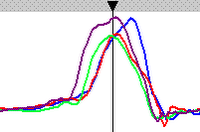
The charts relate to the oar pressure of rowers in a four. In "Coach Thrasher's" words, the underlying idea is that

"the force applied to the boat is the SUM of everyone rowing. If we can sum the peak-power for each rower at the same point in time, we'll get the MAXIMUM force applied to the water to move the boat forward the fastest. The higher this maximum force, the faster the boat will go, but the maximum force is the sum of everyone's efforts, so it's important to time it well. (Obviously there are many factors that contribute to boat speed as well, but this force-timing is really important in small boats.)"

"Note an important aspect of this: the boat will go faster by having the best timing, not by hammering the oar through the water! So a weaker crew with better timing will go faster than a stronger yet sloppy crew."

Now, take a look at the graphs. The difference is obvious, but at first may not seem terribly huge. We're told, however, that the better crew is going about 0.3 m/s faster, which works out to about 30 seconds over a 2000m course. Next, think about all the lightweight fours rowing over nearly 5000 meters at the HOCR. If Pitt's power application curve looked like that of the best crew in this analysis, and everyone else looked like the worst (not impossible), it would take a mighty strong crew to hammer the oar through the water hard enough to beat them.

This sort of thing can be difficult to see by the untrained observer, but that is why we have coaches and not personal trainers. As the Peach web site says, "A coach can identify these differences in terms of body movement, posture, sequencing of legs, trunk and arms during the drive etc."

There are a zillion other factors at play here, of course, and I have no idea if Pitt's advantage was power application timing. It may have been something else. For example, even within power application, the moment of maximum application is important too. The point is that seemingly small differences in technique and timing can make large differences in boat speed.


Wednesday, October 25, 2006

Big Ergs = Fast Boats?

Unless a rower has a big erg score, that number is often a closely guarded secret (at least to the outside world). In Pitt's case, however, a reader posted the lightweight four's erg scores and they are what most observers would call modest. Only one rower is below 8 minutes for a 2k (she's at 7:52). Do you know why they don't mind letting the secret out? Because this fall, it no longer matters. What matters is on the water boat speed and that secret is already out.

Long time readers of FITD know that I consider the erg to be the best thing and the worst thing to happen to rowing in the past 30 years or so. Despite the fact that the NCAA doesn't believe the device is rowing specific, the erg's domination of rowing is complete. If you want to inspire awe, you don't talk about a boat's victories, you talk about it's crew's erg scores. Believe it or not, rowing existed Before Ergs. Back in those dark ages winter workouts consisted of lifting lots of weights and running many miles. No doubt there were coaches calculating indices from leg presses and 2 mile run times, but setting a boat was much more of an art. Now, setting a boat seems simple - line up your rowers' erg scores and cut off the list at the top four starboards and the top four ports. As they used to say about computers, no one ever got criticized for buying IBM. Well, no one ever got criticized for racing an erg boat. It's the safe thing to do, but it usually keeps you from breaking out.

What if baseball managers set their rotations by ranking pitchers by the speed of their fastball and taking the top five? Would that work? For sure you'd get a Randy Johnson out of that methodology, but you'd also get a Steve Dalkowski (left). You would not get a Greg Maddux. The truth is that an erg score, like a fastball's speed, garners lots of attention, but it only gives you a partial picture of an athlete. As the saying goes, ergs don't lie, but they don't float either. They are a very useful tool, but that's all they are.

Ergs hurt the sport of rowing when coaches allow the machine to do the coach's job. I think this happens much more in heavyweight rowing than in lightweight rowing, where some coaches aren't rowing coaches, they are personal trainers. They train their rowers on the erg in winter and then set their boats for good the first day on the water. Sure, they do the occasional pause drill, but their work is done in February. If erg scores are truly the way to set the boat, let me tell you how to train in the spring. For your spring training trip, only take your top 8 ergers (the 1V) and keep the rest at home. The way for the others to make the boat is with a better erg score, so don't waste their time on the water, keep them on the erg. During the spring season, put your 1V on the water every day, keep the rest on the erg, and test weekly. What's the point of putting a 2V on the water when the selection criteria is the erg? If they test into the boat, they'll pick up that technique thing.

If there are times to race erg boats the fall is probably one of them. If a coach can get her hammers to actually row well in the fall, she'll have the best of both worlds in the spring. Although you may be surprised to find that a boat of modest erg scores could do so well at HOCR, perhaps the more surprising notion is the idea that a boat pulled together a week or two before the race (as some of Pitt's competitors no doubt were) could beat a long-term crew. If boat speed = erg score (power and fitness) + technique (skill and chemistry) + heart, we know how Pittsburgh made up water on its rivals.

Look, all things equal, a bigger erg does equal a faster boat, but all things are never equal. A coach's job is to discover which things aren't equal and when a deficiency in one part of the equation is overcome by superiority in another. That's what a coach does, not a personal trainer.

One last thing - wouldn't it have been fun to see a Pitt eight, cloned from the Pitt four, race in the light eight event? Who do you think would've won that contest?

Sunday, September 24, 2006

Rowing Gymnasts

While looking through some of last season's race pictures, I was reminded of one of the key signs that a boat isn't going as fast as it could - the rowing gymnast. The rowing gymnast contorts her body each stroke as if she's begging for the intervention of an exorcist. Gymnasts and "the face" usually go hand-in-hand. The face is seen when a rower grits her teeth, sticks out her tongue, or otherwise grimaces mightily, all of which is frequently accompanied by a tossing of the head usually seen on rodeo bulls.

Nine times out of ten these rowers are in the boat because they have the best erg score on the team. A score so good that a coach thinks she has to put up with that flailing body to get the power inside of it. The power has to outweigh the lack of technique, right? Not necessarily. There are plenty of examples every year where the biggest erg is not in the V8. Just as there are plenty of examples where lightweight boats beat heavyweight boats with bigger ergs. You never know until you seat race. The disruption to a crew caused by a flailing body can be serious and can easily outweigh a ten second faster erg score. On top of that, the rower is wasting energy. Every unnecessary movement wastes energy that could be better used on the oar. The same thing with faces. Even a silly face on a steady head wastes energy. It may feel better to think that your gritting teeth show the world just how hard you're pulling, but it just shows the world you could be pulling harder. As a lightweight, every loss in efficiency is big.

The goal in rowing is to have everyone rowing the proper technique exactly the same way at exactly the same time. A mediocre boat rowing together will beat a good boat rowing separately. Look at winning boats and then look at the rest. You'll see where the rowing gymnasts are.